Art For A Fun Run Here Towards A Healthy Heart Weekend.

Saturday, November 3, 2012

Mona-Lisa Exhumed.

Florence's oldest noble families, said that searching for and exhuming the remains of Lisa Gherardini was "a sacrilegious act". Gherardini was the wife of a rich Florentine silk merchant and is believed by many art historians to have been the model for Leonardo da Vinci's best known painting, which today hangs in the Louvre Museum in Paris. They plan to start excavating the site early next month, with the dig expected to take two weeks. If they find the remains of a woman of about Gherardini's age – she was 63 when she died in 1542 – they plan to extract DNA from the bones and compare it with the DNA of her children, who are buried in a nearby church. The team is led by Silvano Vinceti, a self-styled "Sherlock Holmes" of the art history world who claims to have detected secret codes in the eyes of the Mona Lisa and in the landscape which forms the backdrop to the portrait, although his theories have been dismissed by other scholars.

Natalia Guicciardini Strozzi, a member of one of a team of Italian researchers began the hunt for her skeleton beneath a convent in Florence, using ground-penetrating radar to search for evidence of old tombs. They hope to find Lisa Gherardini's remains and to gather enough skull fragments to be able to reconstruct her face. That would enable a comparison to be made with the Mona Lisa to determine once and for all whether Lisa Gherardini was the inspiration for the portrait – an objective that some scholars have said is far-fetched. "My ancestor's remains should be left to rest in peace," said the princess, who is also an actress, winemaker and former ballerina. "What difference would finding her remains make to the allure of Leonardo's painting? The attempt to find her bones seems to me an inappropriate and sacrilegious act." The princess's family own an estate near San Gimignano, the Tuscan village known as the "medieval Manhattan" for the 72 stone towers built by competing families during the Middle Ages, of which 13 remain.
She is a descendant of two noble lines, the Strozzis and the Giucciardinis, and Niccolo Machiavelli worked as a secretary to one of her ancestors. The Strozzis were enemies of the Medicis and the two dynasties jostled for power in Renaissance Florence. Another ancestor, a noblewoman, took drawing lessons from Michelangelo. The princess's blood link to Lisa Gherardini goes back 15 generations. The team of researchers will spend three days using the radar to analyse to a depth of 10ft the soil beneath the cloisters and chapels of the deconsecrated Convent of St Ursula, which is in a state of disrepair.

Lisa Gherardini.


The Mona Lisa  painting by Leonardo Da Vinci has been portrayed as an epiphany of art history. A once off product from the art decadence from fifteenth century. Its just shear grandeur of oils a portrait from a college beauty, its oils almost came true experimentation by the famous genius Leonardo. Although it would be nice to analysis the skeleton of the painted figure Lisa to gain a better perception of the woman who was carried in the painting. The most widely accepted theory are Mrs Gherardini is believed to have been born in Florence in 1479. At the age of 16 she became the second wife of a wealthy silk merchant, Francesco del Giocondo, with whom she had five children. She is believed to have died in a convent in Florence at the age of “63 in 1542”.Speculation was fuelled by the enigmatic nature of the work and the fact that it was unlike most other portraits of that time. The panel is unsigned undated and bears nothing to indicate the sitter’s name with in this painting or if he was even payed. Art historians have variously claimed that the Mona Lisa depicts Leonardo’s mother as many would like as price would follow this story. But various theorist say she was a commission. Or a famous Florentine courtesan whom he couldn’t marry but leads to Mrs Gherardini. Also speculation she was even the artist though no evidence and is unlikely as given the circumstances or maybe a suspecting mother of an Ere again price could prevail. But as an outcast child who life was often threatened its unlikely this portrait was of his mother. He did a few of these canvases  as some of the main contenders include, 

As you see the top picture it done by a graphic design template with hand pressed coloured thumb tacks as holographic mirrored concave imagery kinda a plasma screen, as it gives a more three dimensional view. May god bless Leonardo R.I.P. if you see this kit box know that art view received no patronage but theirs hope.  
Beatrice D’Este was a noblewoman who was married to Ludovico Sforza, the duke of Milan. Leonardo worked at the duke’s court in the 1490s. According to this theory, Leonardo often would see the woman while he was painting “The Last Supper” for the Monastery of Santa Maria delle Grazie in Milan, where she went to pray it’s a nice story. Leonardo himself, it seems with several scholars have suggested that the Mona Lisa is a playful disguised self-portrait. A possible allusion to the artist’s presumed homosexuality it’s another unlikely story. Digital analysis has shown that there is a similarity between the facial characteristics of Leonardo and those of the Mona Lisa and also Isabella Gualanda or Cecilia Gallerani then there was a film it should tad its title the last da-vinci-code. Art view prefers the Mary Magdalena story “long lost wife” But society figures of their time although today there is often followers “admirers” of women who even register themselves as temptress “Courtesan Women” it kind of says hands off. 
Plays featuring courtesans were frequently performed during spring fertility festivals to help promote the fruitfulness of humans, animals, and crops. In keeping with this connection between courtesans and fecundity, there are many tales in which a king can only end a drought by sending a courtesan to seduce a celibate sage plant. This theme was enacted in an annual ritual by devises, The sacred courtesans became famous as they came from the temple of Jagannatha in Puri, easy way of celebration of kingship true entertainments. Modern courtesans are more noted for dance than re population of Human species frustrated phobic well a bit of light phobic-entertainment is something art view always look forward to that and the vending machine human. 

Friday, October 26, 2012

Robots that borrow Shoes

These new robots are been made to incorporate agility's that are artistically astonishing using morphing graphs and algorithms at super fast speeds these stylish rubber composites are so flexible they can run the entire electronic of their limbs rightly. The new obot simply climbs stairs effortlessly it could be the future home companion of the future self propelled power unites. These are fitted to pick up power it might not be a bone chilling sight as they look ready made up. Researchers in America have revealed astonishing footage of a human-like robot able to walk, jump and run over almost any obstacle in its path. Eventually it is hoped the technology could be used to create a new breed of robotic. A soldier that would be able to operate in any terrain including a house, as robots helpers capable of being sent into dangerous disaster zones deemed impossible for humans to enter. This  pet pronto making its way across a pit by holding onto a wall. Other entries in the contest are from private firm Schaft and Carnegie Mellon University bring still new slow machines but hope for personal trainers that will ware owners shoes
It’s The shoe wearing robot is also shown leaping up a flight of stairs within owners shoes looking effortlessly as owner pants like a canine that got a kick, balancing itself as it goes, then walking across a thin plank of wood The robot is able to leap tall steps in a single bound - all without losing its balance. The amazing robot, called proto-pet, is expected to be one of those competing in the DARPA Robotics Challenge (DRC) which was announced today. The US military funded challenge is for robots who can operate entirely by themselves. ‘The Department of Defence strategic plan calls for the Joint Force to conduct humanitarian, disaster relief and related operations,' DARPA said in a statement. 'The plan identifies requirements to extend aid to victims of natural or man-made disasters and conduct evacuation operations most robots will come with own singing capabilities have wireless earphones on demand. 
For Some disasters, however, due to grave risks to the health and well being of rescue and aid workers, prove too great in scale or scope for timely and effective human response find robot runes in the opposite direction as everyone’s avoids impending calamity. The robots will compete next year in a series of events designed to show off how they could help out in a disaster zone ‘The DARPA Robotics Challenge (DRC) will attempt to address this capability gap by promoting innovation in robotic technology for disaster-response operations.  The primary technical goal of the DRC is to develop ground robots capable of executing complex tasks in dangerous, degraded, human engineered environments. Robots entered into the contest will also be expected to use tools normally operated by humans. All Competitors in the DRC are expected to focus on robots that can use standard tools and equipment commonly available in human environments, ranging from hand tools to vehicles, with an emphasis on adaptability to tools with diverse specifications. The contest will culminate next year, when the robots will participate in two live events June 2013 and December 2013 if the rewards are right. For anyone who was relying on being able to escape from these no worries have a cylinder that extends around their space maybe they go true shoes like never before.

Monday, October 15, 2012

Binary fission Grid.

As Art View predicts this could be the next big thing and already in Hotels in Berlin, Paris and London are taking part in the experiment, and 40 participants chosen from the Ibis's Face book page can create their own work of art with nothing more than a good night's sleep.The hotel chain created special mattresses which are covered in thin grids, measuring heat, pressure and sound.The 'robot', as it were, receives the data, and plots your movements on the canvas, creating a beautiful design out of your sleep lines.
As Art View came up with the idea of script writing while the body went into a slumber in 2007 a vortex of thoughts simulated into a cosmic being of articulated words. These questions could this be or be it as it could interpolated into upward or downward patterns by typing words of meaning.  This concept was a new and wonderful concept for many. It also was thought to be a nonsensical idea kind of a joke if it could be sold to the masses. By adding some digital imagery as it unlock some of the dream sequences like those beauty stories been lost in ancient forest. When taking this concept trough to the mix of design with the use of sensors, in a binary upheaval. Thus bringing these into expressions’  “I say” emotions as Art view explains. Computer writing for Inept emotion of burial experiences where complete strangers raze a toast to one another. Apply their affirmation about other delicate species in their own words a kind to mix and to enjoy life total delicacies with confidence. Would these writings become known as survival within the human race. I guess what I trying to say life for mammals is fraught with challenges and dangers with the cosmetic forces of death that applies its self in the end.  When life is conceived and a human is born into another part of the world could this happen as thousands of humans meet their reincarnated other families in expressed words. A person not have any link to this times righting lead us into Earths future or is this also left to our imagination. The question remains this is not a joke but the beginning as their maybe some humans who will apply themselves to these simple technologies as there are profits within the curiosity. A person could have many families all unknowns could this be explored all from art view on a home planet called outer Earth. So if you stay at an Ibis hotel soon, you might need to share your room - and with an insomniac artist who works through the night, no less.Still, your companion is a silent robot, and he is working to provide you with a personal work of art like no other. For the Ibis Hotel has employed the robot to watch you while you sleep - hold on, it is not as sinister as it sounds - and paint you an image showing how you toss and turn during your slumber. Draw something: The robot will plot your movements overnight, and with a thin paintbrush it will portray your sleeping patterns Hotels in Berlin, Paris and London are taking part in the experiment - and 40 guests will get their own portrait
The setup requires: A data cable connects the robot to your bed, and the robot will use its ample paint supply to make your portrait Naturally, it will depend on your sleep - a deep sleeper may encourage straight and simple lines, whereas if you thrash around all night, perhaps expect something a little abstract to creep in to your paintings.There is still a month to enter the UK competition, which will give you a night's sleep at the Ibis in Black friars, London.

Wednesday, October 10, 2012

Cybrog TV & Moon Mining.

Private balloon space craft hybrid television advertisements The life sized working prototype of the Polaris rover that could mine the moon in 2015 The Polaris rover is 5 ½ feet tall, 7 feet wide and almost 8 feet long. Moon comes back into reality for a while driving a profit making industries forty years later it a program that should never been scrapped now Polaris rover will search for ice that can be drilled to stock future moon bases Expected to relay live video from the lunar surface throughout its life showing where fresh moon springs will be located replenishing trusty cyber bases. It can move at about a foot a second on 2-foot-diameter composite wheels. Its suspension will enable the rover to rise up over rough terrain, but also lower itself to the ground to perform drilling.  The rover will weigh 150 kilograms, or about 330 pounds, and can accommodate a drill and science payload of up to 70 kilograms. Polaris is a first of its kind solar-powered robot that will search for potentially rich deposits of water ice on the moon. Observations by NASA and Indian spacecraft suggest that a substantial amount of water ice could exist at the lunar poles. That ice could be a source of water, fuel and oxygen for future expeditions, researchers say. Polaris can bore one meter into the lunar surface and can operate in lunar regions characterized by dark, long shadows and a sun that hugs the horizon.  It has been developed for an expedition to the moon's northern pole that would launch from Cape Canaveral on top of a SpaceX Falcon 9 launch vehicle.
Polaris is a flight prototype but has the same configuration as the rover that will eventually land on the moon. It includes a number of flight-worthy components, including wheels and chassis beams constructed of light, but tough composite materials. This will enable Astronautic team members to spend the coming months testing and improving the robot's computer vision, navigation and planning software, and software that can plot the rover's position on the moon within 10 feet. While Curiosity begins to explore the Martian surface, the moon may soon be home to another rover - and this one plans to mine. Astrobotic Technology today revealed Polaris, a rover it hopes to send to the moon on top of a SpaceX rocket in October 2015. It will search for ice that could help future explorers set up a moon base - and is powered by solat panels that give it the appearance of having a mohawk. Polaris will have a drill capable of getting a metre under the lunar surface to look for sign of ice. The Polaris rover will hunt for ice on the moon that can be mined to help set up moon bases for future explorers. Astrobotic led by CMU's William "Red" Whittaker — develops robotics technology for planetary missions. 'It is the first rover developed specifically for drilling lunar ice' said Whittaker. Other robots built by the Field Robotics Center have developed technologies necessary for lunar drilling, but none of them were ever meant to leave Earth. 'What Polaris does is bring those many ideas together into a rover configuration that is capable of going to the moon to find ice,' Whittaker added.
 To find the ice, a rover must operate as close to the dark poles as possible, but not so far that it can't use solar arrays for power, Whittaker said. Polaris has three large solar arrays, arranged vertically to capture light from low on the horizon.The solar arrays will be capable of an average of 250 watts of electrical power.Polaris also makes use of software, pioneered in CMU's NASA-funded Hyperion robot, that keeps track of the rover's position relative to the sun's rays to maximize solar energy and husbands battery power for use in the long shadows and dark regions found at the poles.The lander being developed to drop the lunar mining rover on the moon's surface Whittaker said the lunar day lasts about 14 Earth days, though only about 10 days are suitable for water prospecting at the poles. The Astrobotic team expects Polaris could drill 10 to 100 holes during that time as it locates and characterizes water ice deposits. Astrobotic, in partnership with CMU, is also vying for the Google Lunar X Prize of more than $20 million. Polaris is one of two Moon rovers under development by Astrobotic in competition for the Google contest, which offers a total of $30m in awards to privately funded projects exploring the Moon. First prize – $20m – will be awarded to the company that can 'safely land a robot on the surface of the Moon, have that robot travel 500 meters over the lunar surface, and send video, images and data back to the Earth.'If Polaris successfully survives the long, frigid lunar nights, as anticipated, the prospecting mission could be extended indefinitely. Astrobotic has won nine lunar contracts from NASA worth $3.6 million, including one to evaluate how Polaris can accommodate NASA's ice-prospecting instruments during a three-mile traverse near the moon's north pole.

Saturday, October 6, 2012

Uniform cosmos Phenomenon.

Scientists have given the most accurate estimate yet of how fast the universe is expanding. A team of astronomers used Nasa's Spitzer Space Telescope to clock the expansion of the cosmos at a phenomenal “46 miles per second per megaparsec outward and possible inward a giant magnetic polar casam shortly humans will be able to reach into out of”. American astronomer Edwin Hubble was in the Twenties first to discover that space is constantly expanding and has been growing continuously since its inception.To work out the speed the universe is expanding, astronomers observe variable stars called Cepheids, which are good distance indicators because their intrinsic brightness can be calculated by their pulsing light. If their intrinsic brightness is known, their distance can be estimated by comparing that with their apparent brightness, since the further away they are, the more their light dims.  Glenn Wahlgren, Spitzer program scientist at NASA Headquarters in Washington, told Fox News: 'These pulsating stars are vital rungs in what astronomers call the cosmic distance ladder: a set of objects with known distances that, when combined with the speeds at which the objects are moving away from us, reveal the expansion rate of the universe.'
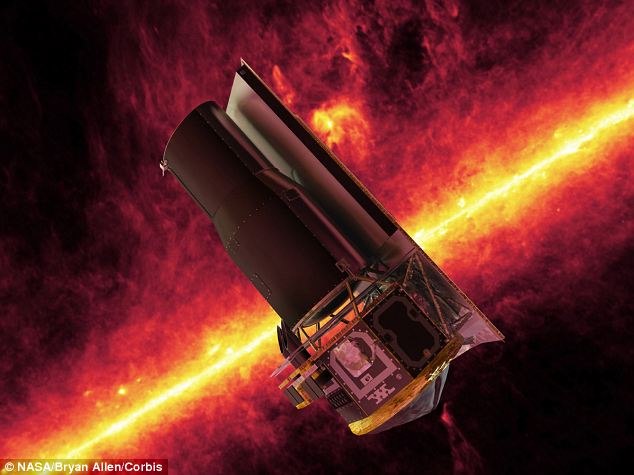
Nasa's Spitzer Space Telescope seen against the infrared sky: The orbital instrument has been used to give the most accurate estimate yet of the rate at which the cosmos is expanding Astronomers now believe that the universe exploded into being about about 13.7billion years ago, so determining the rate of the continuing expansion, known as Hubble's constant, is critical for gauging its age and size. Spitzer's new measurement, which took advantage of long-wavelength infrared instead of visible light, improves upon a similar, seminal study from NASA's Hubble Space Telescope by a factor of three, bringing the uncertainty down to only 3 percent, a giant leap in accuracy for a cosmological measurement.The newly refined value, in astronomer-speak, is: 74.3 ± 2.1 kilometres per second per megaparsec (a megaparsec is roughly 3million light-years). The findings were combined with published data from NASA's Wilkinson Microwave Anisotropy Probe to obtain an independent measurement of dark energy, one of the greatest mysteries of our cosmos.in the late Nineties, astronomers were shocked to learn that the expansion of our universe is actually speeding up over time. In an effort to understand how the cosmos was overcoming the force of gravity, scientists theorised that there must be this dark energy pulling the fabric of the universe apart. 'This is a huge puzzle,' said Wendy Freedman, director of the Carnegie Observatories, who led the latest research. 'It's exciting that we were able to use Spitzer to tackle fundamental problems in cosmology: the precise rate at which the universe is expanding at the current time, as well as measuring the amount of dark energy in the universe from another angle.'
Spitzer was able to improve upon past measurements of Hubble's constant due to its infrared vision, which sees through dust to provide better views of variable stars called Cepheids. These pulsating stars are vital 'rungs' in what astronomers called the cosmic distant ladder: a set of objects with known distances that, when combined with the speeds at which the objects are moving away from us, reveal the expansion rate of the universe. The 'cosmic ladder': NASA's Spitzer Space Telescope has greatly improved on past measurements of Hubble's constant due to its infrared vision which sees through dust to provide better views of stars called Cepheids 'Spitzer is yet again doing science it wasn't designed to do,' said Michael Werner, the mission's project scientist at NASA's Jet Propulsion Laboratory in Pasadena, California. First, it surprised us with its pioneering ability to study exoplanet atmospheres, and now, in the mission's later years, it's become a valuable cosmology tool.'Cepheids are crucial to these calculations because their distances from Earth can be readily measured. In 1908, Henrietta Leavitt discovered that these stars pulse at a rate that is directly related to their intrinsic brightness.To visualize why this is important, imagine somebody walking away from you while carrying a candle. The candle would dim the farther it travelled, and its apparent brightness would reveal just how far. The same principle applies to Cepheids, standard candles in our cosmos. By measuring how bright they appear on the sky, and comparing this to their known brightness as if they were close up, astronomers can calculate their distance from Earth. Spitzer observed ten Cepheids in our own Milky Way galaxy and 80 in a nearby neighbouring galaxy called the Large Magellanic Cloud. Without the cosmic dust blocking their view at the infrared wavelengths, the research team was able to obtain more precise measurements of the stars' apparent brightness, and thus their distances, than previous studies had done. With these data, the researchers could then tighten up the rungs on the cosmic distant ladder, opening the way for a new and improved estimate of our universe's expansion rate. 'Just over a decade ago, using the words "precision" and "cosmology" in the same sentence was not possible, and the size and age of the universe was not known to better than a factor of two,' Ms Freedman said. 'Now we are talking about accuracies of a few percent. It is quite extraordinary.' The findings will be published in the Astrophysical Journal.

Sunday, May 6, 2012

Egg Nebula.

Seeing the gates of heaven? Hubble telescope captures extremely rare picture of dying star emitting ethereal beams of light Swansong in light: this Hubble image of the Egg Nebula shows one of the best views to date of the brief but dramatic phase in a star's life when it runs out of nuclear fuel It's called the pre-planetary or proto-planetary nebula stage and this image shows the Egg Nebula, which was the first pre-planetary nebula to be discovered, less than 40 years ago. Scientists admit many aspects of this phenomenon remain a mystery. NASA and the European Space Agency, who run the telescope, explained that over a few thousand years the hot remains of the aging star in the centre of the nebula, or cloud of dust, heat it up, 'excite' the gas, and make it glow. As some theories believe the process of reaction evolves it breaches the fabric of perpetuation thus leaving a condensed depiction of mass debris a kier puff.
It looks like the gateway to heaven - but this stunning image taken by the Hubble Telescope has captured the dramatic phase of a dying star's lifespan when it runs out of nuclear fuel and emits beams of light like searchlights. At the centre of the image, hidden in the thick dust cloud, is the nebula’s central star. Four beams of light shine out from it through the nebula like searchlights. It is thought that ring-shaped holes in the thick cocoon of dust, carved by jets coming from the star, let the beams of light emerge through the otherwise opaque cloud. They said the cloud had an 'onion-like' layered structure which is caused by bursts of material being ejected from the dying star every few hundred years. Circle of light: this Hubble image from 2011 shows the unprecedented transition of a supernova to a supernova remnant. It was the closest supernova explosion witnessed in almost 400 years The agencies add that because the pre-planetary nebulae have a short lifespan, there are relatively few of them in existence at any one time. Moreover, they are very faint, and need powerful telescopes to be seen, which is why they have only been discovered comparatively recently. Astronomers cannot tell exactly how big the Egg Nebula is because they only know its distance to earth very approximately. It may be larger and further away, or smaller but nearer. It is estimated to be around 3,000 light-years from earth.