Art For A Fun Run Here Towards A Healthy Heart Weekend.

Sunday, November 29, 2009

Cell Life Art Cycle.

Seen under ultraviolet light, a ripening banana's brown spots are each ringed by an eerie blue glow that marks where the cells in the peel are dying, according to a recently released study. The glow comes from substances known as fluorescent chlorophyll catabolites, which are produced by the breakdown of chlorophyll in plants that are undergoing programmed cell death, or senescence.

In plants, senescence causes fruit to become ripe and tree leaves to change color in the fall, while in humans, programmed cell death is linked to many of the degenerative diseases associated with aging. By watching bananas under UV light, researchers can actually watch cell death in action and track its progress at the molecular level—perhaps a first step in better understanding plant life cycles."It's a completely new way to look into a critical process in a cell's life," said study co-author Bernhard Kräutler, a professor of organic chemistry at the University of Innsbruck, Austria.
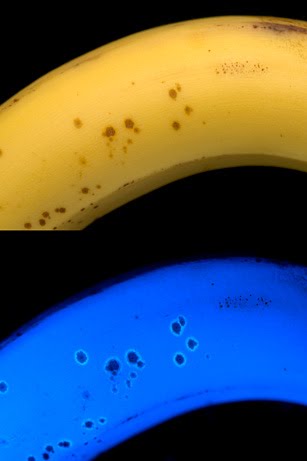
As a bonus, he added, the research can be done without wasting any tasty fruit: "We can measure this phenomenon on the intact banana and study it—and eat the banana later." similar to a painting in still life. with out the moments of diversification of the cells, their more from art viewing later =).

Friday, October 2, 2009

Protein fluoresce

characterization of the technique and demonstrate, as proof of principle, axon guidance by gradients of substrate-bound laminin peptide generated in vitro using LAPAP. If applied to blocks of neuron tissue can manipulate growth sequences that may be the answer to spinal injuries. But for now the laser printing shown here shows spectacular clarity in this Vermeer The protein patterning technique's flexibility and precision is shown in a fluorescent micro scale version of 'Girl with a Pearl Earring'
Santiago Costantino, at the University of Montreal, and colleagues used laser-assisted protein adsorption by photo bleaching to create the protein patterns. He used a laser to bind a fluorescent compound called biotin-4-fluoresce in (B4F) to a protein-coated glass surface. By moving the laser around and varying the intensity of the beam, he created patterns of B4F with varying thickness. He then bound other proteins and antibodies to the surface to create fluorescent and biologically active protein surfaces. Costantino showed that the protein patterns can be used to guide nerve fibres' direction of growth. He says he hopes this will be useful in neuroscience and immunology, for example in repairing nerve damage.

He also demonstrated the technique's flexibility and precision by patterning a fluorescent micro scale version of the 'Girl with a Pearl Earring' painting by Vermeer. 'One of the advantages the method is its accessibility, says Costantino - the technology uses equipment readily available in a typical neuroscience lab. 'We believe that our approach will lead to a major boost in the number of groups that can access new technologies for protein patterning,' he says. 'What impresses me is the dynamic range of protein adsorption that they are able to achieve, coupled to a versatile immobilisation scheme that allows for attaching just about anything to the surface,' says Albert Folch, an expert in bioengineering from University of Washington, Seattle, US. 'Something to be worked out is the long-term stability of the pattern, since cells produce enzymes which can break down proteins during growth and migration. It would be exciting to see if the technique allows patterns of competing signals to be shown to a nerve fibre in real time as the neuron's developmental clock is ticking.'

Saturday, September 26, 2009

New Pop Art.

As part of their TagFP palate Evrogen have launched a new far red fluorescent protein called mKATE2. Within the optical window beyond 650 nm optimal for light penetration in living tissues, the calculated brightness of mKate2 is at least 2-fold higher compared to any monomeric fluorescent protein reported to date. Bright far-red fluorescence Monomer with successful performance in fusions High pH- and photo stability Fluorescent signal is easily distinguished from background fluorescence. here is a clip of a protein as this monomer glows as florescent green a natural occurring science.
These Monomers can be mixed to skin coloured pigments to give an array of optical effects. But the most inspiring of all of this which is relative old techniques used on canvases to give holographic imagery. I could go on to say some of the new polymer's are been used in data and offer cheaper alternatives to expensive technology today. All this multi media is yet to become a new prospect. These technologies are been developed to enhance the understanding of medical science will also find there way into fashion houses of the future.

For example a three coloured dress may not be a thing of ones imagination, or a stained white garment staying a beautiful white colour, as this becomes the Art of tomorrow. So let us toast to longevity and a brighter future.

Saturday, September 5, 2009

Masters of Cubism Surrealism

Pablo Picasso (1881-1973) Perhaps the most original and influential artist of the twenty century. Picasso was born in Malaga in Spain, but lived most of his life in France. Throughout his career he experimented with a Variety of styles. His truly original style first emerged during his famed blue period. (1901-1904) in which Pablo worked only in shades of blue. Depicting solitary, melancholy figures. His subsequent period focused largely on circus performances and became known as his rose period (1904-1906). In 1907 he painted Les Demoiselles d’Avignon, which is widely regarded as the birth of cubism. Cubism is an elevated view of a subject stretch across the canvases. This was a new art form for its time. It brought new forms to art (1899-1906) both in architectures, compositions and to every day life this is what makes Pablo such an iconic master.

The depiction of five female nude pictures in sharp, fragmented geometric shapes changed the course of art forever. Thirty years later he painted Guernica, a bold condemnation of blitz Quirigua also known as blanket bombing used in fascist warfare. His truly unique and ever-evolving body of works instantly recognizable the world over. To this day his work elicits mixed reactions, but his embrace of chaos and complete disregard for the accepted rules of art made him a world-class rebel and the father of modern art. The amounts of his works are enormous and can be readily seen for sale in public domain.

Masters of the Impressionist.

Pierre-Auguest Renoir (1841-1919) Born in Limoges, France, Renoir was an impressionist, but unlike Monet, he preferred figure painting to land scape's, and he often used his wife’s children as models. His paintings were often bright and sunny and lively depictions of family life in the parks gardens of Paris. Additionally his numerous studies of the female nude form are considered to be works of great beauty. The swing, the luncheon of the boat party and the series The bathers are among his better known works.

Vincent Van Gogh (1853-1890) This famous tormented Dutchman who is reputed to have sold just one painting in his life time was born in Groot-Zundert, in the Netherlands. In his early thirties, he moved to Paris to live with his brother Theo an art dealer it was there he met the famous artiest of the day. He eventually moved to southern France, where he produced his most famous works, including Starry Night, Sun Flowers and Bedroom of Arles. During his later years it is said that, Van Gogh battled mental illness it is now revealed suffered from alcoholism he was repeatedly hospitalised, but between the bouts of estranged behaviours he produced an astonishing number of vivid, emotional paintings. With his unique trademark of swirling brushstrokes, often in bright blues, greens and yellows. Eventually overcome by the agony of his mental state now known that was partly due to his lost love, he took his own life with a revolver. Today his works which are deemed priceless artworks then were used then as parchment to carry fish and meat his works are considered masterpieces of expressionism.

Wednesday, July 8, 2009

Masters & Neoclassicism.

Rembrandt Van Rijn (1606-1669) Rembrandt is one of the greatest master artists to emerge from the Netherlands, Rembrandt was born in the town of Leiden. Known for his use of grate light and shadow, warm colours and his ability to convey the inner life of his subjects. He produced hundreds of paintings in his lifetime of work. Including roughly a hundred self-portraits. In recent years it has been found that some of the lesser-known drawings and paintings may have been the works of students. But that has done nothing to diminish his impact on the art seen. The Night watch and the return of the Prodigal Son are considered to be two of his greatest works to date.

Claude Monet (1840-1926) Born in Paris, the master Impressionist is perhaps best known for his landscapes set in the french countryside and his idyllic scenes of the french middle classes. Much of his work identifiable by his use of soft pastel colours favoring purples, orange, blues and greens. His fascination with the outdoor light led him led him to paint several series of paintings depicted the same scene in various stages of daylight. Among his famous works are Water Lilies, The Haystack series and the Woman In The Garden.

The Masters Of The Renaissance.

While the pantheon of great historical artists is a vast one, there are certain names that have been elevated over time to iconic status. These are the names recognized by the masses, even if their individual histories are unfamiliar to most. To help place them in time and to grasp the essence of their contributions. Here at art view is a quick review of these arts also while looking at art one can learn some of the most valuable things. When viewing coinage on the next topic that art view will go into great depth, in its explanations. This will briefly touch on the topic of patronage a most valued thing in any of the progresses or grate endeavours given true history leading into our modern ere.

Leonardo da Vinci Born in(1452-1519) outside the city of Florence an orphan, Italy Leonardo was a trained artistic painter who travelled true out Italy establish himself as a true master. His works inspired an entire generation of Italian artists, including Michelangelo, Botticelli and Raphael. A truly unique figure with greatness in vision. a genius, he created hundreds of inventions and even drew plans for varied flying aircraft's. his best-known master pieces are the Last Supper, New inventions and Mona Lisa also some bronze horses in France one such is pre cast "1495 called Grand Cavallo 24'in height" for much of his works are brought on world tours and are really impressive.

Michelangelo Born in (1475-1519)Michelangelo di Lodovico Buonarroti Simoni in town of Caprice, Italy. He is today one of the most revered figures in art history. Known for his coleuses life like marble sculptures and exquisite paintings. Many of his works were later commissioned by the roman catholic church and deal with religious imagery in new and unimagined way. The spark given to Adam "before the electrons were tough of" He was also an a Accomplished architect and poet who designed and carried out completion of the Vatican. and like so many artists, achieved grate fame in his life time both in Florence under Medici's and in Rome under the pope. Among his most famous works are the frescoes on the ceiling of the Sistine Chapel and the last Judgment and the sculptures pieta and David.