Art For A Fun Run Here Towards A Healthy Heart Weekend.

Sunday, January 22, 2012

Amateur Astronomer.

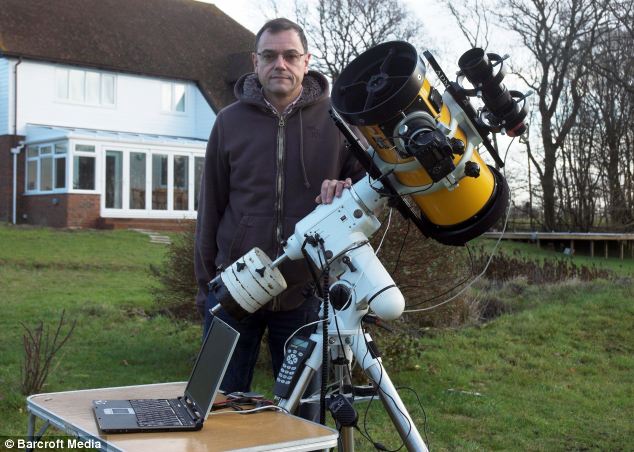
A determined amateur astronomer, mathematician Mark Shelley, has captured stunning views of the stars, using very long exposures to 'soak up' as much light as possible as his motorised telescope tracks across the sky.Amazingly, it's all done on a second-hand telescope he received as a Christmas present in 2006.People are generally amazed at the quality of images produced by relatively simple equipment,’ explained Mr Shelley. ‘Before the age of digital cameras, it was only the professional observatories that could produce such images.‘I am one of the few people who have successfully taken pictures of the International Space Station in orbit,’He said. Taking pictures of the Space Station requires precise knowledge of where the ISS is going to fly over and extremely precise timing - it moves at 17,500mph. ‘By their very nature they are very small images because the Space Station is in orbit 250 miles above the ground. ‘However, the solar panels, astronaut living quarters and laboratories can be clearly seen.’Mark moved to his present five-bedroom detached home in the Kent countryside to take even more spectacular images of space phenomena. ‘I now live in a village outside Tenterden in Kent, where the sky is much darker than Sidcup,’ he said.‘This has made a huge difference, allowing me to tackle beautiful but faint objects that would previously have been impossible' ‘It's a great feeling to see a faint grey fuzzy object in the eyepiece of a telescope and then take a long exposure photograph of the same thing.'‘Suddenly, bright colours spring to life and huge amounts of extra detail emerge. ‘It is a delight to see the camera reveal details that are too faint for the human eye to even see.’ Mark uses long exposures to capture his stellar-images, keeping the shutter of his camera open for up to five minutes to trap the light from the stars - light from some of the most distant objects Mark captures has travelled for up to 70 million years to reach his eyepiece. The planet Mars. This was imaged by replacing the telescope eyepiece with a webcam. But the biggest challenge is that the stars and all celestial objects are moving across the sky during the course of the night,’ said Mark.‘Everyone is familiar with ‘star trail’ pictures taken with a stationary camera.‘To avoid these star trails it is necessary for the telescope to accurately follow the motion of the stars. ‘This is achieved by using a motorised telescope mount whose axis is aligned with the Earth's axis.’
Saturday, January 7, 2012

The Dream Chaser.


The Dream Chaser space plane is derived from the HL-20 lifting body developed by NASA. Photo Credit: SNC With NASA’s fleet of orbiters retired and being prepared to go on display in museums, NASA is dependent on the Russian Soyuz for access to the International Space Station (ISS). NASA currently pays Russia $63 million per seat for trips to the orbiting laboratory. Many within both NewSpace and established space companies have stated their intent on reducing the amount of time that the U.S. is in such a position. NASA also has worked to assist companies that are working on CCDev2 to either meet or exceed their deadlines. NASA is hopeful that these developments will allow the space agency to turn over transportation to the ISS to commercial firms by 2016. If all goes according to plan, the Dream Chaser could be one of many 'space-taxis' that would supply transportation services to the International Space Station. Image Credit: SNC In the case of SNC, NASA increased what the company was paid by an added $25.6 million. SNC had already been awarded $80 million as their part of the CCDev2 contract. After this boost in funding, SNC announced that the drop test would be held next summer. The Dream Chaser design is based primarily off of the HL-20 lifting body design and is capable of carrying seven astronauts to orbit. Dream Chaser is designed to launch from Cape Canaveral Air Force Station located in Florida atop a United Launch Alliance (ULA) Atlas V 402.

Sunday, November 27, 2011

Astronauts’ May Grow Own.

Astronauts travelling to mars may be more like farmers who depend on having trays of crops in small storage compartments. Supplying enough food for a full round trip to the once red earth like planet called mars, with current engine technology would take a whole earth year at minimum to complete this round trip. It would be the biggest supply challenge for modern space explorers to date. So mission planners have compiled a range of data as to how this process could begin. But confusion sets in as a review to the days of pioneer there were out posts had been adopted. This was like mini satellites hook up with travelling capsules so to supply food water so fare rs then could continue the journey. The most efficient ways have all put been repudiated as inefficient to the modern idea. So it would be down to who could build a space station to travel this distance. This process would have to be done in space like the International space station. But this feat of human ingenuity would be seen as hugely costly if done by current methods. So the answer may be in sending missile parts and stores building supplies’ with question how to get into space. This could be done from jet fighter aeroplanes putting parts beside ISS in shape of missile like parts to complete a large space .transporter this could be partly an inflatable with a radioactive shield. It would have to be equipped for every eventually including emergency escape pods. Whatever the Marian concept, story of a transporter space ship for humans will probably have to be constructed in space. A space station could stay in orbit over mars it would need to have a high technical garden to allow for oxygen waste and a gravitational field. This station needs to provide variety of tasty menus that lift spirits of first astronauts. The thing about space is the “Moon Buggy” is still fully functional ready to go even today. Only the earth climate is inductive to horrendous corrosion. Earth weather leaves almost everything into a corrosive waste like products; this is not a problem more of a challenge. As for having another Earth like planet it would have the benefit with almost zero corrosion, with only ware tare on parts this is minimal. So what can be constructed would be owned by the people or the country that constructed the station and it would be in a lasting state. These built the technology carry a beacon long after their creator. Still to have fully function technologies in space or orbit planets is a costly process. Most will be un-manned waiting for time when the argument, or for an industry is justified to put in place. But the greatest treats to human life come from an asteroid collision at near light speed with Earth. It would crack our planet like mars, so the argument to our future is look at our counterpart Mars and to this I just wouldn’t delay. NASA Astronauts’ may go to mars in 2030 that 70 years after landing on moon and the mapping of the moon are so complex almost to the inch it spectacular. Moon landings provided industries that have generated countless sums of wealth example cars. Dr Maya Cooper from NASA space Food Systems Laboratory said a five year mission to mars would require almost £,145 KG 7,000 lbs food per person. It is a clear impediment to lots of mission scenarios. This was announced annual meeting of American chemical society in Denver Colorado. At art view we would like to see a Martian base on mars looking out for brother Earth. As the Moon is nearer it more of a possibility to the occupation of the moon but it has less resources than mars. Having a function base on another planet can do a lot, both in learning how planets interact this can give Human civilisation its biggest ever achievement and how to manage resources more efficiently here on Earth. The need for new approaches to implement a bio regenerative system to growing crops in space for consumption is apparent. Bio regenerative systems evolve growing multi task plants that not only provide food but releases oxygen for astronauts’ to breathe. These plants would remove carbon dioxide they exhale and alga that can purify water. Ideally these plants would have few inedible parts. Take up little room potential space crops would include bean sprouts, oats, lettuce, onions, potatoes, herbs, cabbages, grapes algae small fish many more. It couldn’t be any easier, it might just be like putting a rocket program in place for fighter aircraft and this could put current space technologies to shame.

Monday, October 31, 2011

Plants on Mars

As part of a proposed mission that could put plants on Mars as soon as 2007, University of Florida professor Rob Ferl is bioengineering tiny mustard plants. He's not altering these plants so that they can adapt more easily to Martian conditions. Instead, he's adding reporter genes: part plant, part glowing jellyfish -- so that these diminutive explorers can send messages back to Earth about how they are faring on another planet.Right: Green-glowing Arabidopsis thaliana for a future pioneer of Mars? Rob Ferl and the University of Florida. The plants can be genetically wired to glow with a soft green aura when they encounter problems. Within a garden grouping, some plants could report (by glowing) low oxygen levels, while others might signal low water or, say, the wrong mix of nutrients in the soil. Thriving plants won't glow at all. They'll look like normal mustard. But plants struggling to survive will emit a soft green light, a signal to researchers that something is amiss. A camera onboard the lander would record the telltale glows and then relay the signal back to Earth. No humans are required on the scene -- a big advantage for such a far away experiment. The plants' designer genes consist of two parts: a sensor side to detect stress and a reporter side to trigger the glow

Sunday, October 16, 2011

Robotic Moon Town.

New exciting and to help humanity move asteroids’ out of the way self power project soon to be taken very seriously. With a straight face just that dead pan look. On May 1, 2009, during its fifth mission extension, Spirit became stuck in soft soil on Mars. After nearly nine months of attempts to get the rover back on track, including using test rovers on Earth, NASA announced on January 26, 2010 that Spirit was being retasked as a stationary science platform. This mode would enable Spirit to assist scientists in ways that a mobile platform could not, such as detecting "wobbles" in the planet's rotation that would indicate a liquid core. Jet Propulsion Laboratory (JPL) lost contact with Spirit after last hearing from the rover on March 22, 2010 and continued attempts to regain communications until May 25, 2011 bringing the elapsed mission time to 6 years 2 months 19 days or over 25 times the original planned mission duration.

Saturday, October 8, 2011

Art Maths Distance It's Simple.

The speculating within a paper published in Cornell University's online journal arXiv, that if there are stable orbits for photons, there is no reason why there could not be stable orbits for larger objects, such as planets. The problem is that these stable orbits would only exist once you have crossed the threshold of the event horizon, where time and space flow into one another.The event Horizon, at the lip of the black hole, is known as the point of no return. However speed, beyond the event horizon is another domain, known as the Cauchy horizon, where time and space return to stable states. It is inside the Cauchy horizon that life could exist, Dokuchaev argues in a paper published in Cornell University's online journal arXiv,However, the type of life that could exist in those conditions - where they would be subject to massive fluctuating tidal forces - would have evolved beyond ours. The life that could exist there would likely be a civilisation ranked as Type III on the Kardashev Scale. There are three levels to the scale with one being the lowest and three the highest. Humanity is still looking to attain Level 1 status; mastery of its own planet. 'Interiors of the super massive black holes may be inhabited by advanced civilisations... invisible from the outside,' he says. Though that is a spine-tingling thought, Dokuchaev's proposition can only ever remain theoretical. Because nothing can ever escape from a black hole due to its enormous gravitational pull, we will never know if it is true. Art club view question is did life develop and exist in subatomic particles of black hole if so they have to be fast what consists of definition of life probably to humans something that expands to develop this fit the bill perfectly as it on a paradox to what we know as matter define it bonds with out.

Saturday, October 1, 2011

Eventual Inability.

That's a relief - there are many fewer 'mid-sized' Asteroids near Earth than was previously thought. There are roughly 19,500 -- not 35,000. But while the risk of impact is smaller, according to NASA, the majority of them remain to be found. Mid-sized, by the way, isn't small - it refers to asteroids in a size range between 330 and 3,300 feet wide, which could destroy a city-sized area were they to hit Earth. NASA's latest scan used the Wide-field Infrared Survey Explorer, or WISE and took two infrared scans of the entire celestial sky, scanning the entire sky twice in a series of infrared photos between January 2010 and February 2011. The scan aimed to find asteroids 'near Earth' - ie within 120 million miles.
NASA's scientists were cautious about the result, saying only that the risk to Earth could be 'somewhat less' now than they previously thought. Scientists also admit there could be 'up to a million' smaller asteroids that have not yet been detected - which could 'cause damage' if they hit Earth. What is definitely good news is that the likelihood of a 'planet-killer' - the mountain-sized asteroids in the 'large-sized' range, above 3,300ft - appears to have fallen more significantly. There are only 981 of these objects near Earth according to the latest estimates, and NASA has found 911 of them. The scenario, beloved of film directors, where a huge asteroid threatens all life on Earth now looks distinctly unlikely. All near-Earth asteroids that are as big as the one that wiped out the dinosaurs (around six miles across) are thought to have been found by NASA's scans, which use infrared to detect both 'light' and 'dark' asteroids. 'NEOWISE allowed us to take a look at a more representative slice of the near-Earth asteroid numbers and make better estimates about the whole population,' said Amy Mainzer, lead author of the new study, published in the Astrophysical Journal, and principal investigator for the NEOWISE project at NASA's Jet Propulsion Laboratory in Pasadena, Calif. WISE captured a more accurate sample of the asteroid population than previous visible-light surveys because it is difficult for visible-light telescopes to see the dim amounts of visible-light reflected by dark asteroids. 'The risk of a really large asteroid impacting the Earth before we could find and warn of it has been substantially reduced,' said Tim Spahr, the director of the Minor Planet Center at the Harvard Smithsonian Center for Astrophysics in Cambridge, Mass.