Art For A Fun Run Here Towards A Healthy Heart Weekend.

Saturday, February 18, 2012

Gravitational Vectors.


For the calculation of light use the shortest length preference (WC-s) method, the wave length is chosen to be the one for which the wavelength mesh graph provides the shortest path between the two nodes. Note that this will require the shortest path between s and d to be found for each wavelength mesh graph where these two nodes may be connected; the overall shortest path and the corresponding wavelength is then chosen for assignment to the new light-path requested. ² For the ®rst-®t preference (WC-f.f) method, the wavelength mesh graphs are sequentially as ordered in a ®xed pre-determined sequence best results here is a picture of a Quasar. art view has often attempted to gain the resonance with in calculated gravitational Field Calculation of gravitational vector forces. gravitational force is directed outward giving a potential expansion upward in any direction possibility of floating or anchoring. in F=(G M1 M2)/r^2. G=6.67*10^-11m^3 kg^-1 s^-2. M1 is mass of object 1 in kg. M2=mass of object 2 in kg r=distance between two objects.F=(G M1 M2)/r^2 G=6.67*10^-11m^3 kg^-1 s^-2
M1 is mass of object 1 in kg M2=mass of object 2 in kg r=distance between two objects
This is art view point towards anomalies in forces these can be applied to objects separately. This is not a certainty may take a little development as many have challenged. Its the simplicity of the characteristics addressed to the rings "a concept" towards fission flying but a tip look over these and explain in the terms listed understandable by art view.


Monday, February 13, 2012

Art Of Speech.

Viral vectors are used to transplant larger chromatid into the new mammal this would be a smaller canine two Geno tides that allow its throat to develop along with the cortex lobe to allow a dog to speak. Large amount of work has been done on parrots and other birds burung cockatiel the "Cockatoo” has rather simple process for communication easier to manipulate it is a rather an uncomplicated process. As a DNA molecule looks like two ladders with one of the sides taken off both and then twisted around each other. The rungs of these ladders meet (resulting in a spiral staircase-like structure) and are called base pairs. Base pairs are made up of nitrogen molecules and arranged in specific sequences. Millions of these base pairs, or sequences, can make up a single gene, specifically defined as a segment of the chromosome and DNA that contains certain hereditary information. The gene, or combination of genes formed by these base pairs ultimately direct an organism's growth and characteristics through the production of certain chemicals, primarily proteins, which carry out most of the body's chemical functions and biological reactions. In both types of therapy, scientists need something to transport either the entire gene or a recombinant DNA to the cell's nucleus, where the chromosomes and DNA reside. In essence, vectors are molecular delivery trucks. One of the first and most popular vectors developed were viruses because they invade cells as part of the natural infection process. Viruses have the potential to be excellent vectors because they have a specific relationship with the host in that they colonize certain cell types and tissues in specific organs. As a result, vectors are chosen according to their attraction to certain cells and areas of the body. One of the first vectors used was retroviruses. Because these viruses are easily cloned (artificially reproduced) in the laboratory, scientists have studied them extensively and learned a great deal about their biological action. They also have learned how to remove the genetic information that governs viral replication, thus reducing the chances of infection! Retroviruses work best in actively dividing cells, but cells in the body are relatively stable and do not divide often. As a result, these cells are used primarily for ex vivo (outside the body) manipulation. First, the cells are removed from the "Cackatoo body", and the virus, or vector, carrying the gene is inserted into them. Next, the cells are placed into a nutrient culture where they grow and replicate. Once enough cells are gathered, they are returned to the body, usually by injection into the blood stream. Theoretically, as long as these cells survive, they will provide the desired therapy. Another class of viruses, called the adenoviruses, also may prove to be good gene vectors. These viruses can effectively infect non-dividing cells in the body, where the desired gene product then is expressed naturally. In addition to being a more efficient approach to gene transportation, these viruses, which cause respiratory infections, are more easily purified and made stable than retroviruses, resulting in less chance of an unwanted viral infection. However, these viruses live for several days in the body, and some concern surrounds the possibility of infecting others with the viruses through sneezing or coughing. Other viral vectors include influenza viruses, Sindbis virus, and a herpes virus that infects nerve cells.Scientists also have delved into non viral vectors. These vectors rely on the natural biological process in which cells uptake (or gather) macromolecules. One approach is to use liposomes, globules of fat produced by the body and taken up by cells. Scientists also are investigating the introduction of raw recombinant DNA by injecting it into the bloodstream or placing it on microscopic beads of gold shot into the skin with a "gene-gun." Another possible vector under development is based on dendrimer molecules. A class of polymers (naturally occurring or artificial substances that have a high molecular weight and formed by smaller molecules of the same or similar substances), is "constructed" in the laboratory by combining these smaller molecules. They have been used in manufacturing Styrofoam, polyethylene cartons, and Plexiglas's. In the laboratory, dendrimers have shown the ability to transport genetic material into human cells. They also can be designed to form an affinity for particular cell membranes by attaching to certain sugars and protein groups.

Tuesday, February 7, 2012

The Fun Flyer

Here at Art View is sure everyone will want to fly inside one of these tubular frame fun flier perfect for any Tirane especial it a desert but should be out for Christmas 2012 either as a toy or to make professional films. The radio-controlled sphere, roughly the size of a basketball, was built for search and rescue operations, specifically to fly in and out of buildings weakened by earthquakes or other natural disasters. This device uses its on board camera to transmit live images of whatever it sees with its camera. At art view tried to gain recognition with a spinning revolving motor, with the "The Roller Ball" only now ten years on and this most exciting camera. Also Wise Labs has work on a flying robot that uses frequency to re-energise with its main power ingredient of sucrose this could be built on a dime built from polymers using new engineering process of a net nylon structure. Ultra modern battery power technologies use wave formation energy to energize to date it has emerged it is now possible. Here with a plan of modified Human Flier its the "The Fun Flyer" 'Because of its spherical shape, it can land in various positions and tumble to move around the ground. 'It zips through the air, glides smoothly around corners, and negotiates with ease, all the while emitting a barley audible soft hum with more on its detail of this design later.

Sunday, January 22, 2012

Amateur Astronomer.

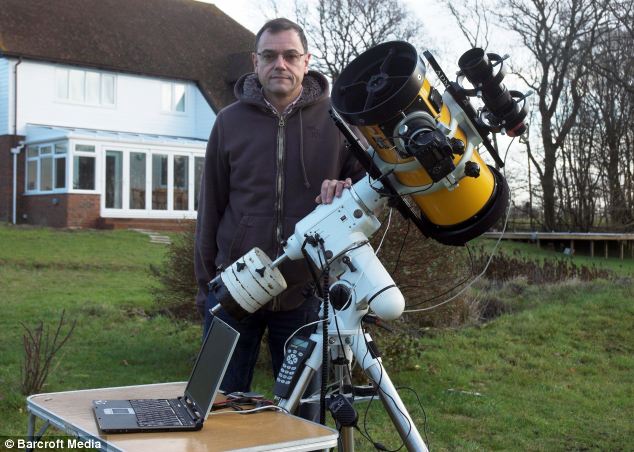
A determined amateur astronomer, mathematician Mark Shelley, has captured stunning views of the stars, using very long exposures to 'soak up' as much light as possible as his motorised telescope tracks across the sky.Amazingly, it's all done on a second-hand telescope he received as a Christmas present in 2006.People are generally amazed at the quality of images produced by relatively simple equipment,’ explained Mr Shelley. ‘Before the age of digital cameras, it was only the professional observatories that could produce such images.‘I am one of the few people who have successfully taken pictures of the International Space Station in orbit,’He said. Taking pictures of the Space Station requires precise knowledge of where the ISS is going to fly over and extremely precise timing - it moves at 17,500mph. ‘By their very nature they are very small images because the Space Station is in orbit 250 miles above the ground. ‘However, the solar panels, astronaut living quarters and laboratories can be clearly seen.’Mark moved to his present five-bedroom detached home in the Kent countryside to take even more spectacular images of space phenomena. ‘I now live in a village outside Tenterden in Kent, where the sky is much darker than Sidcup,’ he said.‘This has made a huge difference, allowing me to tackle beautiful but faint objects that would previously have been impossible' ‘It's a great feeling to see a faint grey fuzzy object in the eyepiece of a telescope and then take a long exposure photograph of the same thing.'‘Suddenly, bright colours spring to life and huge amounts of extra detail emerge. ‘It is a delight to see the camera reveal details that are too faint for the human eye to even see.’ Mark uses long exposures to capture his stellar-images, keeping the shutter of his camera open for up to five minutes to trap the light from the stars - light from some of the most distant objects Mark captures has travelled for up to 70 million years to reach his eyepiece. The planet Mars. This was imaged by replacing the telescope eyepiece with a webcam. But the biggest challenge is that the stars and all celestial objects are moving across the sky during the course of the night,’ said Mark.‘Everyone is familiar with ‘star trail’ pictures taken with a stationary camera.‘To avoid these star trails it is necessary for the telescope to accurately follow the motion of the stars. ‘This is achieved by using a motorised telescope mount whose axis is aligned with the Earth's axis.’

Saturday, January 7, 2012

The Dream Chaser.


The Dream Chaser space plane is derived from the HL-20 lifting body developed by NASA. Photo Credit: SNC With NASA’s fleet of orbiters retired and being prepared to go on display in museums, NASA is dependent on the Russian Soyuz for access to the International Space Station (ISS). NASA currently pays Russia $63 million per seat for trips to the orbiting laboratory. Many within both NewSpace and established space companies have stated their intent on reducing the amount of time that the U.S. is in such a position. NASA also has worked to assist companies that are working on CCDev2 to either meet or exceed their deadlines. NASA is hopeful that these developments will allow the space agency to turn over transportation to the ISS to commercial firms by 2016. If all goes according to plan, the Dream Chaser could be one of many 'space-taxis' that would supply transportation services to the International Space Station. Image Credit: SNC In the case of SNC, NASA increased what the company was paid by an added $25.6 million. SNC had already been awarded $80 million as their part of the CCDev2 contract. After this boost in funding, SNC announced that the drop test would be held next summer. The Dream Chaser design is based primarily off of the HL-20 lifting body design and is capable of carrying seven astronauts to orbit. Dream Chaser is designed to launch from Cape Canaveral Air Force Station located in Florida atop a United Launch Alliance (ULA) Atlas V 402.

Sunday, November 27, 2011

Astronauts’ May Grow Own.

Astronauts travelling to mars may be more like farmers who depend on having trays of crops in small storage compartments. Supplying enough food for a full round trip to the once red earth like planet called mars, with current engine technology would take a whole earth year at minimum to complete this round trip. It would be the biggest supply challenge for modern space explorers to date. So mission planners have compiled a range of data as to how this process could begin. But confusion sets in as a review to the days of pioneer there were out posts had been adopted. This was like mini satellites hook up with travelling capsules so to supply food water so fare rs then could continue the journey. The most efficient ways have all put been repudiated as inefficient to the modern idea. So it would be down to who could build a space station to travel this distance. This process would have to be done in space like the International space station. But this feat of human ingenuity would be seen as hugely costly if done by current methods. So the answer may be in sending missile parts and stores building supplies’ with question how to get into space. This could be done from jet fighter aeroplanes putting parts beside ISS in shape of missile like parts to complete a large space .transporter this could be partly an inflatable with a radioactive shield. It would have to be equipped for every eventually including emergency escape pods. Whatever the Marian concept, story of a transporter space ship for humans will probably have to be constructed in space. A space station could stay in orbit over mars it would need to have a high technical garden to allow for oxygen waste and a gravitational field. This station needs to provide variety of tasty menus that lift spirits of first astronauts. The thing about space is the “Moon Buggy” is still fully functional ready to go even today. Only the earth climate is inductive to horrendous corrosion. Earth weather leaves almost everything into a corrosive waste like products; this is not a problem more of a challenge. As for having another Earth like planet it would have the benefit with almost zero corrosion, with only ware tare on parts this is minimal. So what can be constructed would be owned by the people or the country that constructed the station and it would be in a lasting state. These built the technology carry a beacon long after their creator. Still to have fully function technologies in space or orbit planets is a costly process. Most will be un-manned waiting for time when the argument, or for an industry is justified to put in place. But the greatest treats to human life come from an asteroid collision at near light speed with Earth. It would crack our planet like mars, so the argument to our future is look at our counterpart Mars and to this I just wouldn’t delay. NASA Astronauts’ may go to mars in 2030 that 70 years after landing on moon and the mapping of the moon are so complex almost to the inch it spectacular. Moon landings provided industries that have generated countless sums of wealth example cars. Dr Maya Cooper from NASA space Food Systems Laboratory said a five year mission to mars would require almost £,145 KG 7,000 lbs food per person. It is a clear impediment to lots of mission scenarios. This was announced annual meeting of American chemical society in Denver Colorado. At art view we would like to see a Martian base on mars looking out for brother Earth. As the Moon is nearer it more of a possibility to the occupation of the moon but it has less resources than mars. Having a function base on another planet can do a lot, both in learning how planets interact this can give Human civilisation its biggest ever achievement and how to manage resources more efficiently here on Earth. The need for new approaches to implement a bio regenerative system to growing crops in space for consumption is apparent. Bio regenerative systems evolve growing multi task plants that not only provide food but releases oxygen for astronauts’ to breathe. These plants would remove carbon dioxide they exhale and alga that can purify water. Ideally these plants would have few inedible parts. Take up little room potential space crops would include bean sprouts, oats, lettuce, onions, potatoes, herbs, cabbages, grapes algae small fish many more. It couldn’t be any easier, it might just be like putting a rocket program in place for fighter aircraft and this could put current space technologies to shame.

Monday, October 31, 2011

Plants on Mars

As part of a proposed mission that could put plants on Mars as soon as 2007, University of Florida professor Rob Ferl is bioengineering tiny mustard plants. He's not altering these plants so that they can adapt more easily to Martian conditions. Instead, he's adding reporter genes: part plant, part glowing jellyfish -- so that these diminutive explorers can send messages back to Earth about how they are faring on another planet.Right: Green-glowing Arabidopsis thaliana for a future pioneer of Mars? Rob Ferl and the University of Florida. The plants can be genetically wired to glow with a soft green aura when they encounter problems. Within a garden grouping, some plants could report (by glowing) low oxygen levels, while others might signal low water or, say, the wrong mix of nutrients in the soil. Thriving plants won't glow at all. They'll look like normal mustard. But plants struggling to survive will emit a soft green light, a signal to researchers that something is amiss. A camera onboard the lander would record the telltale glows and then relay the signal back to Earth. No humans are required on the scene -- a big advantage for such a far away experiment. The plants' designer genes consist of two parts: a sensor side to detect stress and a reporter side to trigger the glow